
HDD or Open-Cut Trenching? A Cost and Time Comparison
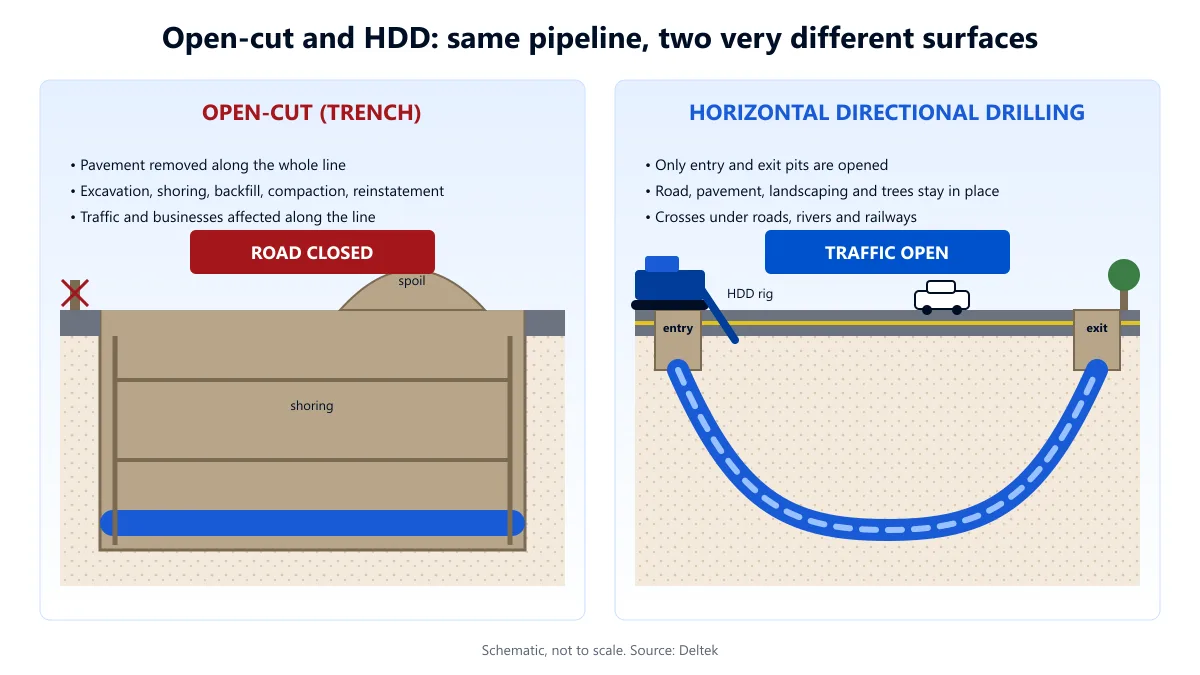
There are two ways to put a pipe or cable underground: dig a trench along the whole route and lay the pipe in it (open-cut), or open a pit at each end and drill the distance in between (horizontal directional drilling, HDD). There is no single answer to which one is cheaper, but it is quite clear under which conditions each one wins. This article puts the two methods side by side using the same criteria.
The two methods in brief
Open-cut is the oldest and best-known method in utility construction. Pavement is removed along the route, a trench is excavated, shored where necessary, the pipe is laid on bedding, the trench is backfilled and compacted, and finally the surface is reinstated. Every step is visible, easy to inspect and within reach of almost any contractor.
In HDD there is no trench. An HDD rig set up at the entry point first drills a slim pilot bore, the bore is reamed in stages to the required diameter, and finally the pipe string is pulled in from the exit side. On the surface only the entry and exit pits are visible; the road, river or railway in between stays untouched. The three stages are described on the HDD construction method page.
Where to look for the cost
Comparing open-cut and HDD on a price-per-metre basis is misleading. The open-cut bill is made up of several items; the HDD bill is largely a single item. The comparison only makes sense on total project cost.
What goes into the open-cut total
- Excavation and spoil: trench volume, haulage and tipping. Deeper trenches increase both volume and shoring at the same time.
- Pavement removal and reinstatement: saw-cutting asphalt, lifting kerbs and paving, then rebuilding all of it. In urban streets this is often more expensive than the excavation itself.
- Backfill and compaction: suitable fill material, compaction in layers, laboratory testing. Done badly, it comes back a few months later as a settling road.
- Traffic management: road closures, signage, enforced night work, sometimes police or municipal escort.
- Conflicts with existing utilities: every water, gas, power and telecom line met along the trench has to be diverted or supported.
- Indirect costs: lost trade along the closed street, time lost in traffic, dust and noise complaints. These never appear on the contractor’s invoice, but they are on the client’s and the public’s account.
What goes into the HDD total
- Mobilisation: bringing the rig, mud system and crew to site. A fixed cost independent of length, which is why it raises the price per metre on short crossings.
- Drilling: pilot bore, reaming and pullback. Varies with ground type, diameter and length; we describe the eight cost drivers on a separate page.
- Drilling fluid: bentonite, polymers, and recycling or disposal of the fluid.
- Entry and exit pits: two small excavations, two small reinstatements.
The difference is visible in the lists: in open-cut the metre price is driven by excavation but the total is inflated by reinstatement and traffic; in HDD the metre price looks higher, but almost nothing follows it.
Which is more economical where?
| Condition | Open-cut | HDD |
|---|---|---|
| Open land, short distance, shallow line | ✔ usually cheaper | mobilisation dominates |
| Urban street, heavy traffic | reinstatement and traffic costs high | ✔ |
| Road, motorway or railway crossing | often not permitted | ✔ the only practical option |
| River, stream or canal crossing | cofferdams and dewatering needed | ✔ |
| Dense existing utilities | conflict at every line | ✔ passes beneath them |
| Rock | rock excavation costly but visible | done with dedicated tooling, metre price rises |
| Very large diameter (above 2000 mm) | ✔ | at the limit for HDD; pipe jacking or microtunnelling considered |
| Gravity line (tight gradient) | ✔ gradient easy to control | guided pipe jacking or microtunnelling more suitable |
The essence of the table: if there is nothing on the surface worth protecting, open-cut wins; if there is, HDD wins. The thing worth protecting may be a motorway, a river bed, a historic pavement or simply a street too busy to close.
Duration
In open-cut, duration grows in proportion to trench length: every metre is excavated, laid, backfilled and reinstated. In HDD, a large share of the time goes into set-up and the pilot bore; reaming and pullback progress comparatively fast. The longer the crossing, the clearer HDD’s time advantage becomes. In cities there is a further point: open-cut often has to be done at night or under partial closures, which stretches the programme; HDD can work in daylight with traffic flowing.
Risk and quality
The two methods carry different risk profiles:
- In open-cut, the most frequent problems are damage to unrecorded utilities and poor compaction leading to settlement of the road. Both show up after the job is finished.
- In HDD, the risk concentrates in missing ground information: an unexpected rock layer, a fill with large cobbles, or a frac-out under shallow cover. All of these are largely foreseeable through a geotechnical investigation carried out before work starts. We explain what each ground type changes in our geotechnical investigation article.
On quality, HDD has one advantage: the pipe string is welded and tested on the surface under controlled conditions, rather than jointed in a trench between water and mud.
Environmental impact
Open-cut disturbs vegetation, tree roots and surface drainage along the whole line; spoil haulage and reinstatement add traffic and emissions. In HDD the surface is not disturbed, spoil volume is small and in river crossings the water body is never touched. In projects requiring an environmental impact assessment, this difference alone often decides the method.
Five questions before deciding
- Is there anything above the alignment that cannot be closed or disturbed?
- Does the line cross a road, a railway or a watercourse?
- Are existing utilities dense, and is their mapping reliable?
- Is the ground known? Is rock or cobbles expected?
- How tight is the gradient tolerance of the line?
If the answer to the first two is “yes”, the comparison is almost over. The remaining three decide how the HDD will be priced.
What Deltek recommends
We do not recommend the same method for every project. Our site survey and feasibility study are free of charge, and at that stage we put the total cost of open-cut and HDD in the same table; on some short, unobstructed crossings we do recommend open-cut. From our Istanbul and Izmir offices we provide horizontal drilling services across Türkiye in the 2–2000 mm diameter range; contact us to have your project assessed.
Get in touch about your project.
0850 888 3585