
Geotechnical Investigation for HDD: How Ground Type Decides Method and Tooling
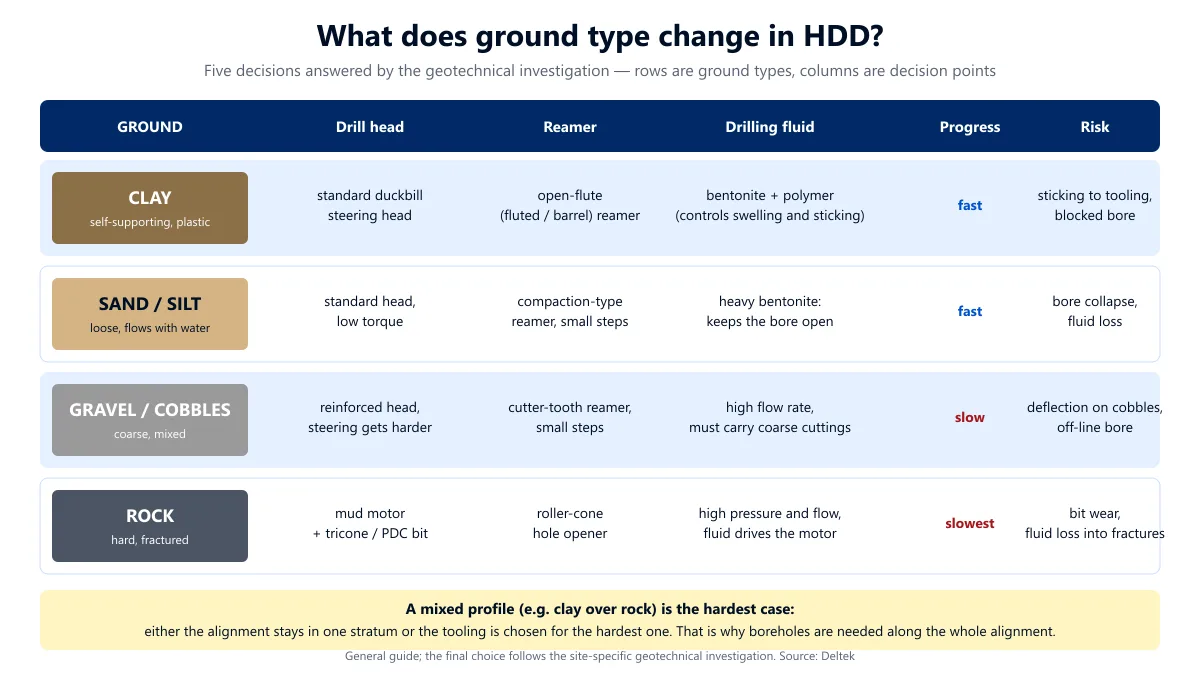
Most problems in horizontal directional drilling start at the desk rather than underground: with tooling chosen and a price given before the ground is known. Two crossings of the same length and diameter, one in clay and the other in cobbly fill, are two different jobs; the head, the fluid, the rate of progress and the risk all change. This article explains why a geotechnical investigation is indispensable for HDD and how ground type affects each decision.
What does the investigation answer?
The answers expected from a geotechnical investigation on an HDD project are clear:
- Which strata are present along the alignment, and at what depths do they start and end?
- Where is the water table, and does it change with the seasons?
- Is there rock; if so, how deep, how strong and how fractured?
- Are there cobbles, old foundations, fill or abandoned utilities in the ground?
- How permeable is the ground; is fluid loss to be expected?
These five answers translate directly into five decisions: steering head, reamer, fluid recipe, rate of progress (and therefore duration and price), and the risk plan.
Where should boreholes be drilled?
The investigation is carried out with boreholes along the alignment. Their number depends on crossing length and ground variability; on a short crossing one borehole at each end may do, on a long and variable alignment regular spacing is needed. Boreholes should reach several metres below bore depth, because the profile may be deepened to avoid a poor stratum found in the investigation.
One detail is often missed: boreholes should be drilled a few metres to the side of the alignment, not on it. Every borehole on the alignment becomes a ready channel for drilling fluid to escape to the surface during the bore. The same reason applies to grouting the borehole with bentonite-cement once it is finished.
What to look for in the report: stratigraphic section and borehole logs, SPT (standard penetration) values, grain size distribution, Atterberg limits, uniaxial compressive strength and RQD in rock, water level readings.
What changes with ground type?
Clay
Clay is the most comfortable ground for HDD: it is self-supporting, the bore wall stays stable and progress is fast. The problem is swelling and sticking. Clay in contact with water gains volume and narrows the bore; it sticks to the head and rods, raising torque, and can block the bore during reaming. The answer lies in the fluid: polymers that control swelling and cut sticking are added to the bentonite. A standard duckbill steering head is sufficient; in reaming, open-flute reamers cut the clay and carry it out with the fluid.
Sand and silt
Loose, coarse and especially saturated sand does not support itself; the bore stands by the pressure of the fluid inside it. Here the fluid’s job is less to carry cuttings than to support the bore, so a denser, more viscous bentonite mix is used and circulation is never interrupted. Compaction-type reamers are preferred in reaming; instead of cutting the ground, they displace it into the bore wall, both opening the bore and consolidating the wall. Steps are kept small. The main risks are bore collapse and fluid loss into permeable ground; pullback must be continuous and fast.
Gravel and cobbles
The ground HDD likes least is coarse gravel and cobbly fill. A small head can neither break nor push aside a cobble in its path; it skids off the surface and deflects off line. Steering becomes difficult in the pilot bore and the reamer snags during reaming. Reinforced heads, small reaming steps and high-flow fluid capable of carrying coarse cuttings are needed; often the right solution is to move the alignment into a cleaner stratum above or below the cobbly layer. Where the cobble content is high, pipe jacking or microtunnelling is considered instead of HDD; in pipe pushing the face can be reached by hand, and in microtunnelling the cutter head breaks the cobbles.
Rock
HDD in rock is possible, but with a separate tooling set: instead of a standard head, a fluid-driven downhole motor (mud motor) with a tricone or PDC bit is used. The fluid not only carries cuttings but drives the motor, which calls for high pressure and flow. Reaming is done with roller-cone hole openers in narrow steps. This is the ground with the slowest progress and the highest bit wear; duration and price are planned accordingly. The fracturing of the rock matters as much as its strength: fractured rock brings fluid loss and sudden deflections, while massive rock is slow but predictable.
Mixed profiles
In practice the hardest case is not a single ground type but a layered profile: fill over clay over rock, or gravel lenses within clay. A head advancing along the boundary of two strata deflects from the hard one towards the soft one; a profile running between rock and clay loses direction each time it enters and leaves the rock. Either the profile is designed to stay within one stratum, or the tooling is chosen for the hardest one. The only way to see this at the desk rather than on site is enough boreholes along the alignment.
Groundwater is a separate variable
The water level changes the decision independently of ground type. Sand above the water table supports itself to a degree; below it, it flows. Clay below the water table sticks to the head more. A high water table requires dewatering in the entry and exit pits, and fluid pressure calculations are made against the water. Seasonal variation must be allowed for; fill that looks dry in summer may be saturated in winter.
What happens without an investigation?
Starting without ground knowledge has three typical outcomes: starting with the wrong head and stopping (a tooling change costs days), deflecting off line in unexpected rock or cobbles (the pilot bore is redrilled), and the price not holding (quoted for clay, drilled in gravel). This is why ground type comes first among the factors that determine the cost: any price given without knowing the ground is an estimate.
How Deltek handles the investigation
At tender stage we ask for the client’s geotechnical report; if there is none or it does not cover the alignment, we say so plainly in the site survey and agree the scope of the investigation together. Based on the results we select the method (HDD, pipe jacking or microtunnelling) and the tooling, and explain in the tender which method we recommend in which ground and why. We have dedicated tooling for rock drilling, and work across Türkiye in the 2–2000 mm diameter range from our Istanbul and Izmir offices. Contact us to share the ground information for your project.
Get in touch about your project.
0850 888 3585